

Plotter vs. Pantser
Or how I became a Plotser

I have a confession to make; plotting is tricky for me. I struggle to figure out what should come next when I’m in the middle of a work-in-progress. The problem for me is that there are too many choices about where a story can go. My mind is like one of those “choose your own adventure” stories. I marveled at writers like Suzanne Brockmann who routinely write eighty-page outlines before they start writing. For a long time, I refused to outline while writing fiction. I felt it would stifle my creativity if I had a road map of where the story should go. That boggles my mind. I couldn’t do that. Writing a three-page synopsis is a struggle. For example, I took a romance writing class years ago at Hunter College, and one of the assignments involved writing an outline. I wrote a 29-page outline and no longer wanted to write the novel when I was done!
Since I’m more of a pantser than a plotter, my first drafts are filled with scenes that make no sense, characters whose names change halfway through the novel, and endings that make no sense. That’s if I finished the first draft. Often I would get so frustrated that I never finished the book. I have quite a few half-finished novels sitting on my hard drive.
This year, I decided to try to plot out my cozy mystery, but since I can’t entirely abandon my pantser ways, I’m plotting it out several chapters ahead of time. Before I started writing, I knew that my amateur sleuth would be the curator at a library/museum (despite my best efforts, her name has changed three times!), who the victim would be, and who the murderer would be.
Before plotting, I pulled out my copies of Hallie Ephron’s Writing and Selling Your Mystery Novel and Jane K. Cleland’s Mastering Suspense, Structure, & Plot. These are two of the best books I’ve found about writing mystery fiction. I still need to purchase a copy of Cleland’s Mastering Plot Twists: How to Suspense, Targeted Storytelling, and Structure to Captivate Your Readers.
I’m using the three-act structure instead of the five-act structure for my cozy mystery, which reminds too much of Shakespeare’s plays. Act One includes the incising incident (the murder) and set up exposition, about 50% of the book or 75 pages. Act Two, which is the meat of the book (about 150 pages), includes the rising action, the mid-point, the clues and red herrings, road blocks, ending with the amateur sleuth hitting a wall. Act Three is the novel's denouement where the sleuth figures whodunnit and the culprit is arrested.
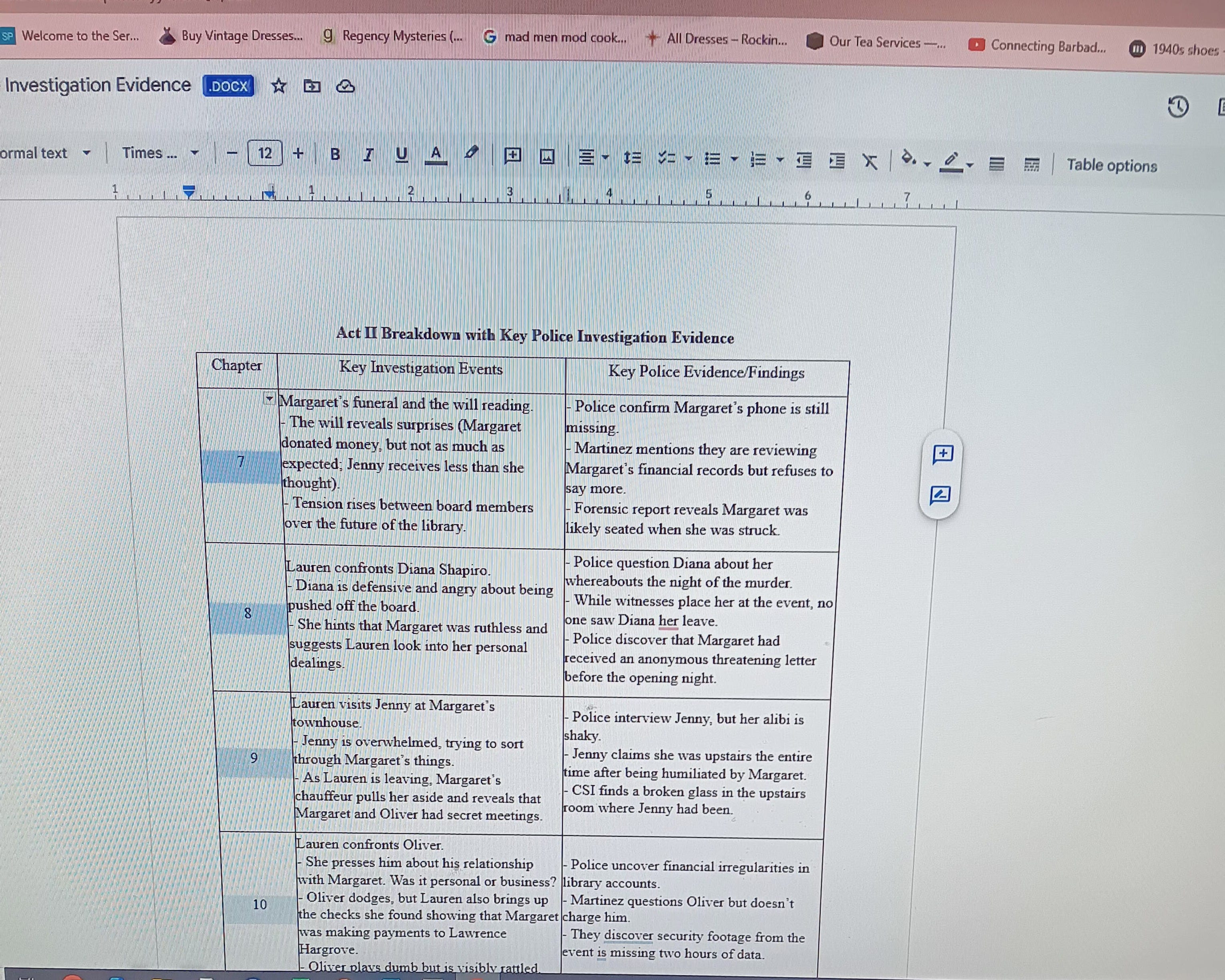
I’ve written the first four chapters, which end with the murder. Chapter five will pick up with the police investigation. I’d managed to plot most of the second act. I was so proud of myself! Still, after reading it over, I realized that I completely forgot the police investigation that is occurring alongside my amateur sleuth poking her nose where it doesn’t belong. Oops!
I had to go back through the outline to add moments where my amateur sleuth and the cops collide. Plotting like this has also been very helpful in ensuring that I have clues and red herrings that take the case in another direction. I’ve become very good at identifying them in novels and TV shows, but developing them in your work is another thing entirely.
I’m almost done with the outline for Act Two. I still need to tweak a few things, but I may wait to add them until I get to that chapter. I’ve also been using my morning walks to help me plot certain aspects of the book. My day job is hybrid, and I work from the office twice weekly. I’m lucky to live twenty minutes away so I’ve been walking to work since the pandemic. The other day, I came up with a great red herring that I hadn’t thought of before. I couldn’t believe that it hadn’t occurred to me. So even though I’m trying to outline/plot ahead, I’m still making discoveries, which I worried about.
Writers: Are you a plotter or a pantser? Please let me know in the comments!
What I’m Reading:
Tracy Clark’s Hide/Echo/Fallen: I don’t read many police procedurals. I can’t remember the last time I read one, but I was going through a reading slump recently and thought it was time to try something different. Tracy Clark is a member of Crime Writers of Color (as am I), Sisters in Crime, and she’s won the Sue Grafton Memorial Award twice. I picked up the first book in her Harriet Foster series and binged the second book. I’m about to read the third. They are gripping and fast-paced. If you like watching Chicago P.D., then you’ll love these books.
What I’m Watching:
Dope Girls: This is a new BBC series I learned about from FrockFlicks. I’ve only seen the first episode (I have a VPN) but it’s intriguing. Dope Girls is a historical drama television series based on the nonfiction book Dope Girls: The Birth of the British Drug Underground by Marek Kohn. Julianna Nicholson plays Kate Galloway, who eventually runs a nightclub in Soho and Eliza Jane Scanlen plays Violet Davies, one of the first women hired by the Metropolitan Police Department. I’m sure where the series is going but I’m along for the ride. From the previews, it looks like Kate funs afoul of a group of Italian gangsters in 1920s London.